Friday, September 2, 2011

Raymond: Bent & Good


In the movie Bent, we see various events take place that show victimization. We know a little history on the laws of homosexuals prior to the movie, by reading paragraph 175. It was a law in Germany being gay was against the law. This way of life was seen as “unnatural”. Max knowing he was a gay man knew he was already in a compromising situation going to the gay party at the nightclub. Anytime there were large gatherings of homosexuals, the risk of getting caught rose higher. Society was intolerable of this life and wanted nothing to do with anyone that was gay. The major event that in Bent, which begins the victimization is when the nightclub gets raided. Just as we have seen and heard in other documentaries of the Holocaust of the Soldiers making their way into people’s homes and forcing them out. This is exactly what had taken place in the club to the gays. When Max and Rudy, who is his lover are sent the concentration camp; he betrays his partner and exchanges his pink triangle (a symbol showing he was gay) to the yellow star (which meant Jew). At this time, the homosexuals where condemned to concentration camps as were the others, but they were beaten more due to their sexual preference. Rudy is completely caught off guard when Max switches his mark, he thought they were in a serious relationship and hand a much stronger bond than that. In the situation Rudy becomes the victim and Max is the victimizer. Up until this, we were all under the impression that Max and Rudy were both the victims. At one point or another we all are either victims or can then easily turn our defense mechanism on and become the victimizer. Max would not have ever probably turned on Rudy, but when the times got rough. He only cared about saving himself through the brutality of the Nazi soldiers. Later as the movie progresses, we see Max fall in love with another man he meets in the concentration camp. When he meets Horst, he sees that he is wearing his gay symbol with such great pride. Max quickly realizes that it is ok for him to be gay and have others know. They go through many events that finally make Max see that accepting his identity makes him a stronger man.
In Good, it is a play that shows us the victimizer, Halder, whom is a German soldier. Halder goes about his everyday work as a Nazi soldier as if it is any other job. He shows himself throughout the play to me as a guy just trying to complete his career. He makes checks on the various camps as he is told. As all the other Nazi soldiers they do not have hearts, they are on missions. They were asked to seek out horrific acts of violence. If you are a person that is going to work for a job that is going to kill others, due to their faith, how can you really be anything but a victimizer? Both the movie and book show the true sense of victims versus victimizers. In the book I feel we do get to see a lot more of these roles going both ways.

Ramon- Week 2; Victims of Victims

The question of victim and victimizer is a tough problem to judge. When analyzing a play, novel, or film, one can believe to sympathize with one character for being victimized, but then the tables could turn when the victimized turns victimizer. First, in Cecil P. Taylor’s 1981 play Good, the reader is supposed to sympathize with Halder in the beginning. He is merely an educated person who happens to be a part of Nazi Germany. He becomes involuntarily in a way brainwashed by the Nazi rule. The vicious victimization circle begins with Prof. Halder’s way of thought from a cool and collected instructor to one who sees the Nazi ‘Final Solution’ as perfectly legitimate. Thus, his victimization involuntarily turned Halder into a victimizer of countless innocent people.

Moving onto an easier way to see victimization, the 1997 film based off the 1979 play by Martin Sherman, Bent, is the story of victimization of homosexuals in Nazi Germany. First, the main character, Max, plays both role of victim and victimizer. In the most basic terms, he is a victim of the Nazis because he is a homosexual and a prisoner for that fact. He is also a victimizer as he is brainwashed by the Nazi way. When he is given his identification patch, he was supposed to get a pink downward facing triangle to show his homosexuality. However, he struck a deal with the SS so that he could have a gold star, symbolizing that he was a Jew. He is brainwashed so much that he denies his homosexuality and condemns homosexuality altogether. Thus, he becomes a victimizer to his homosexual work friend, Horst.

Back track a bit in the film, there is another situation in this film I would like to examine. After Max, is taken into captivity onto the train, Nazi SS Officers bust their way onto Max’s train car. The SS choose Max’s ‘lover’ of sorts, Rudy, because he is wearing glasses; a sign of weakness in the Nazi view. They him into the next car and beat him half to death. The SS brings back the half-beaten man, and asks Max a series of questions on if he knows the man. He tells Max to hit his ‘lover’ with a club. For a brief second, the camera shows the commanding SS officer sitting down alone and rubbing his eyes in sadness, he also has glasses himself. That shows an example of how the organization is the victimizer in many cases and how the system victimizes the individuals within that system.

In conclusion, it is not a valid solution to try to eliminate a certain victimizer. Rather, it makes more sense to seek out the organization from which that victimizer comes from.

Trujillo - Even within the victimized, there are victimizers.

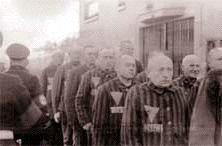
A traveling exhibit by the U.S Holocaust memorial exhibit

We are members of the human race. A race that is known throughout history as one that destroys their own in petty wars and jealous rages. A race where men victimize each other.

The film Bent shows the story of a particular man, Max, who begins his story being a victimizer. He sleeps with men and women left and right, playing with the emotions of especially his young dancer friend and roommate Rudy, who he seems to have some sort of a relationship with. Very quickly, as the film progresses, we see the horrible turn of events, where Max and Rudy are persecuted for being gay.
I believe that the point in which Max truly became a victim in the film is when he was forced to deny his friendship with Rudy and when he was forced to beat him. Here, the most basic animalistic tendency showed... the want and need of survival. Here, compassion was taken away and replaced with mind altering fear.
It was interesting to see the humanity of the victimizers (mainly the SS guards) in this film. It was interesting to see that while they still tortured these men and women, they were human too. They needed water to cool down and could fail a few times trying to light a cigarette. They played like children in the snow and drank and had fun. They did all these things with the victims in the concentration and work camps suffering and dying in front of them. They had already lost sight of the humanity of the people in front of them.
Unfortunately, you see Max revert to his ways as the victimizer as he forces Horst to join his work, a job that clearly drove Horst mad much sooner than it did Max, a job that Horst obviously never wanted to have. A job that forces Horst to fall in love with a man that can't love back. Even within the victimized, there are vicimizers.
Good, a play about a man who decided to join the Nazi party to advance his career, portrays the main character as the victimizer. What other title would joining the Nazi party give you, his advancements on euthanasia helping the party annihilate millions of lives? But my, aren't we quick to judge. Couldn't one argue that Halder, the protagonist, was a victim of a movement? Not really given much of an option?


Tran: The Bad in the Good


It is easy to simply say that Halder was the victimizer while Max was the victim, but the line between the two isn’t always so simple. The two men represent different roles people took on during the war, but neither character is completely the embodiment of either ‘victimizer’ or ‘victim’. Halder can easily be branded as the victimizer, but he wasn’t always that way. At first, Halder is a bit opposed to the Nazis because he doesn’t want to have to join the party, but when it changed his institution and society, he thinks about it over. His best friend is Maurice, who happens to be Jewish. Halder is a bit cynical about Nazism and this new government and is even hopeful that the Nazis won’t be in power for long. As the play goes on, he realizes in order to keep his position in the university he would have to be recognized with the Nazi party and does so. As he gains ranks, he starts to question his beliefs and morality and rethinks this whole Jewish thing. He begins to get annoyed with seeing Maurice and only really wants him for the summer cottage to be with Anne. Halder can’t even see Maurice’s anxieties about getting out the country, and later goes to think to himself why weren’t the Jews smart enough to leave when they had the chance. He never physically did anything to the Jews himself unlike Freddie who goes and round them up, but his indifference towards it is all the same. He is a victimizer because he becomes part of that pack mentality of the Nazi Nation and does nothing to help his friend or even care about what happens to the Jews. He becomes a part of the solution to the Jewish problem.

Max is a victim in the film Bent because he was unjustly persecuted. Granted, Max was a bit reckless with his life and chose to bring him a Nazi officer, who was later tracked down which lead to Max and Rudy’s arrest. Max is considered a victim because didn’t do anything to hurt anyone, but was hunted down by the government for his sexuality and him and Rudy were caught and sent to a camp because of it. On the way, Rudy was killed and Max was forced to commit a horrific act to prove he wasn’t homosexual. Rudy was truly a victim too because he was beaten to death just because of the fact he had glasses and later when they knew he was homosexual. Max also is a victimizer to Rudy because he does not acknowledge an acquaintance between them in order to protect himself. In a way, we can see how some regular Germans could have been victimizers and victims because they didn’t do anything to protect the Jews, but they would have put themselves in harm’s way if they did too by not obeying the laws. You really have to take a side sometimes and Max kind of play on both sides a bit in order to protect himself and Rudy at first, but later just himself until he met Horst.

This may be a bit of a stretch, but in a way you could look at Max as the victimizer and Horst as the victim. Max has the mindless task of moving rocks from one pile to another and bribes an officer to make Horst join him. Max might think it’s the best job ever, but he wants Horst there to talk to him. Horst even mentions how heavy the rocks are and how they will go mad soon from doing this kind of mindless labor. Max selfishly thought he knew what was best for Horst and brought him to work there for his own personal satisfaction and subjected Horst to even harsher conditions than before. Horst then becomes a victim of Max’s desires, even though they are from love; it ends up killing Horst. It’s a complex situation people were put in during the war; sometimes it was too difficult to remain neutral and away from the problems. You have to pick sides sometimes and even when you don’t think you’re doing wrong, you’re committing a heinous crime of indifference by letting things happen without preventing them from doing so.

Tregre: Week 2, CP Taylor, God Hates Fags

Bent and Good were a breath of fresh air for this week's reading and movie watching assignment. So often we only hear about the genocide of the Jews, but we also forget the lives of gypsies, homosexuals, and twins lost in the Holocaust too. I was not well informed of what the homosexuals went through and this has definitely broken my heart and opened my eyes. I kind of wanted to take a different approach when answering the blog question. Share my thoughts, then give my answer in a short, concise way.

Bent was a powerful movie. At first, I was a bit shocked. Within the first five minutes I saw a naked guy using the restroom. However, it was the truth. It was raw and nothing was hidden because it was on TV. This made it more realistic. Max, the main character was a promiscuous gay man in the 1930s. He gave the movie a lot of entertainment because he was so suave. When he brought home the Sturmabteilung man home, that is when you could see there would be trouble. This is when you could feel the terror strike. Hitler had just decided to get rid of homosexuals. The brutality of it all still shocks me. They killed the Sturmateilung man immediately. Even after this, Max refused to leave his boyfriend. When he turned down the papers, I knew that was where it was going to go downhill. I can understand why Max beats Rudy to death, even though I was furious, when they were being transferred to a concentration camp. It all comes down to the psychology of it. This does not mean he was a bad person. People all react different. When one is put in a life or death situation, you cannot determine what one will do until they are in it. It is a fight or flight deal. He even went as far to have sex with a dead girl to prove that he was not gay. He chose life instead of honor. He did what he had to do in order to survive and choosing to deny being a homosexual was his choice. People in the camp were all Jewish, but people in the camp who were gay had to wear a pink triangle and branded as different from even being a Jew. Plus, he would have been subject to torture and inhumane experiments. However, things change after Max falls in love and meets Horst. Horst was the opposite. He chose honor over death. How powerful is that? Horst owned up to being gay and did not deny it. He wore the pink triangle with honor and dignity. After he is shot by the guards, Max decides to die with honor and dignity for what he is. A proud homosexual who can love just as much as a heterosexual.

This movie touched me and once again exposes what happened during that terrible time. I was proud of him dying with honor instead of killing another person and denying who he really is. I am very idealistic so it pleased me. He died for his love and being what he truly was.

Good was a fantastic play. I grew up in theatre and reading plays, so sometimes it is easier for me to read plays. This play had the most interesting character, Halder. He went from being a professor to a Nazi. His best friend was even Jewish. It was 1933, and the pressure was intense, but it was a pure betrayal. Halder and Maurice, his friend, would debate about their dilemmas and Maurice turns out to be quite a complex character. He was Jewish, but had unresolved feelings about it. It is absurd how an intelligent, good man, such as Halder, became a coldblooded murderer. This book was great to explain my previous blog of how one man could possibly get perfectly good, moral people to become brutal, mass murderers. Halder like I said was a good man, he was preoccupied by his mother, a marriage without love, his children, and his love for one his students. Being that he is pro-euthanasia, it attracts the Nazis. He does not just join them, but becomes a fully active member. Halder was lured in by the fact that his membership of being a Nazi made him feel important and belong, that he did not believe that what he was doing was bad. The irony of the play is that while Halder loves Jews, Maurice, a Jew himself hates them. Halder becomes brainwashed and becomes a Nazi himself. When one takes a step back, Halder is just a product of his society. He is human and turns a blind eye to things that are too evil to fathom. This was a great, eye opening read from a new perspective.

This play also reminded me of the Westboro Baptist Church, or as many people know them as the "I Hate Fags" group. These people honestly believe in their religion what they say is true. So it is so hard to condemn people, though personally I would like to give those people a piece of my mind, who believe that they are helping society. Their membership is pure brainwash and they are passionate about what they believe in.


Great reading this week and definitely food for thought. Now to go back and answer the blog question originally asked after I wanted to share my thoughts on the reading and movie, a victimizer is actually the victim. A victim usually does not retaliate. A victimizer does. I look at it differently. In order for a person to be able to have the capacity to inflict pain on another, they have to feel pain. It is the wrong way to react, but when people are traumatized their pain comes out in different ways. In this reading and movie, both characters became the victimizer. For example, when Max killed his boyfriend, he took his pain and shame out on him. He was only for himself in his helpless situation. When people develop a learned helplessness, they either become strong or weak, in this case they became weak. When people talk themselves into believing what they are doing is right, then there is no stopping them.

Rogers: Victim or Victimizer in "Good" and "Bent"


Superficially these two characters certainly fulfill the roles in the blog prompt; Max is the beleaguered homosexual in Dachau and John Halder is the professor elevated to SS rank. But if you look a little closer, I am in agreement that they play both rolls.

Max is, as stated in the lecture, a playboy. He lives with Rudy, but he seduces and brings home a big blonde specimen of an SS officer. He deals cocaine at the club and is just the suavest Mother around. Max is good at making deals, which is how he survives so long in the camps. He is a survivor which means that at his core he is willing to do just about anything to live; even watch and take part in the brutal beating of his lover. Many people, I'm tempted to say MOST people, would be unable to desecrate the corpse of a thirteen year old girl. But Max does it because he knows, right from the start, that he is a survivor and will do anything it takes to live as long as he can. Of course that all goes downhill by the end of the movie as he discovers that every man has his breaking point. But if you look closely at Max, he embraces his victimization because in the world of the camps, obedience is what will keep you alive. He deals with his victimization because it suits his purpose to be obedient to the guards.

John Halder is a very passive and definitely befuddled character in C.P. Taylor's "Good." Having unwittingly aided the Nazi death machine in their desire for a "blemish"-free Germany, he can only sit back and watch as he is promoted several times in rank to one of the higher SS offices. He is, in essence, a victim, just as Gluckstein is; things happen to him, not of his own volition and power. But he, in his ignorance and complete moral unawareness, has very few qualms about his aiding the Nazi's. About his spiffy Nazi uniform he says, "It is a terrible thing, but a wonderful thing, to get into a uniform," acknowledging the terrible things that happen when the individual joins the ranks of the group at large.

By the ends of both of these stories, their roles are affirmed, however. Max throws himself upon the electric fence because with his acceptance of his love of Horst and thus his homosexuality, he realizes that he cannot go on surviving in his frozen, inhuman state of mind. Once he looks beyond his own safety and realizes that the Nazi's cruelty has beaten him, he embraces his victimization and gives himself up to death. As Halder recounts his trip to Auschwitz, to the accompaniment of prisoners playing a Schubert march, he realizes the reality of what he has been working for. In the film version of the play, Viggo Mortensen, in his Nazi uniform walks wildly around the camp, to the prisoners, personifying the Nazi elite, as he realizes that his simple little work of fiction about euthenasia has spiralled and probably infuenced the ovens of burning Jews that he is surrounded with and which he has been working towards when he embraced the mindless state of victimizer.

Baudot- Week 2: Good/Bent

Max (the main character) at Dachau

As mentioned in our blog prompt for this week, the main dynamic that the reader or audience encounters in both the play, Good, and the film, Bent, is the victimizer/victim role that each of their main characters take on through the duration of the text/film. In Good, John Halder is a literary professor who examines the concept of compassionate and “worthwhile” euthanasia, which stems from his personal experiences with his ill mother. His book is recruited by the Nazis to serve as a form of basic principle of which to base the Nazi reasoning behind killing. The term “good” is repeated often throughout the play, and it seems to appear at times when things seem to be at their worst. We see Halder go from a husband and father who experiences problems at home who consults his close friend Maurice (a psychologist), to a man that chooses to commit adultery despite all that he has to lose and, by joining the Nazi Party, turns against his Jewish best friend (Maurice). Halder refers to his wife, his children, his lover, and himself as “good,” yet all of the things that he classifies as good seem to be the things that are creating the most unhappiness and distress in his life. He, conversely, views his recruitment; opportunity for leadership, and high regard from the Nazis as an opportunity that he cannot turn down. We are led to believe that this is an honorable offer, according to Halder, and joining the party will be a good choice for him. Halder turns on his best friend because he is Jewish, and Maurice notices this drastic change in Halder and condemns him for being influenced so heavily by his new political allegiance. Halder tells Maurice, “What has happened is we have confused subjective fantasy concepts like good, bad, right, wrong, human, inhuman as objective, immutable laws of the universe. Jews are bad, German are good. Like a stone falls to the ground, it is a moral act to get rid of the Jews (page 84).” This Nazi ideology that Halder convinces himself of, as a victimizer, is ironic due to the fact that earlier on in the play, Hitler and the Doctor discuss what constitutes “good” humanity, and that, repeatedly, Halder claims to believe that capitalism will resurface once the collapse of the Nazi campaign/takeover occurs. Overall, Good exposes the complexities behind human society and the impact that this new government potentially had on an individual’s morality and sense of self.

Bent contrasts, yet compliments, Good. Likewise, the role of the victimizer is turned into the victim, and the viewer watches as a love affair develops between two victims in particular: Max and Horst. Max is not only a victim as serving as capture by the Nazis, but also a victim to his unwillingness to accept his homosexuality outwardly. He refuses to wear the pink emblem on his coat shirt, which he claims at first is the smarter move because he will be treated better. But as the movie develops, and this better treatment is shown to be true, we see that his refusal is more just an unwillingness to accept that being gay is acceptable. As he falls more in love with Horst, and commits suicide over his loss, we see that Horst has taught him to be unafraid. Max’s sense of awareness is bettered because of Horst, and by the end of the film, he seems to have found his own, personal way of defeating the oppression and captivity of the Nazis by committing suicide. The movie mentions earlier on that the Nazis hated when the Jews killed themselves because it took away their power over them. Max has finally taken a claim over his personal life, which was robbed from him and Horst in captivity.

There is a moment between Anne and Halder in Good where Halder tells Anne, “We’ll be alright. We’ll help each other, won’t we? As long as we are together, I feel that. That’s the first time I’ve felt anything like that in my whole life. It doesn’t matter what happens around us as long as we have each other (page 39).” There are several scenes in Bent that this moment between Anne and Halder can be compared to between Max and Horst. They give each other the love they are no longer allowed to have by the Nazis while in captivity. They support each other, look out for one another, and Max, particularly, promises “not to let go” of Horst. He even reminds himself of this promise upon Horst’s death. In both Bent and Good, above all else, we see how Nazi Germany robbed its victims of their personal selves, regardless of whether or not this influence made them better or worse people because of it. 

A scene from another adaptation of Good capturing the differences/dynamic between Nazi Germany and Horst, representing the defense for homosexuality.