The question of victim and victimizer is a tough problem to judge. When analyzing a play, novel, or film, one can believe to sympathize with one character for being victimized, but then the tables could turn when the victimized turns victimizer. First, in Cecil P. Taylor’s 1981 play Good, the reader is supposed to sympathize with Halder in the beginning. He is merely an educated person who happens to be a part of Nazi Germany. He becomes involuntarily in a way brainwashed by the Nazi rule. The vicious victimization circle begins with Prof. Halder’s way of thought from a cool and collected instructor to one who sees the Nazi ‘Final Solution’ as perfectly legitimate. Thus, his victimization involuntarily turned Halder into a victimizer of countless innocent people.
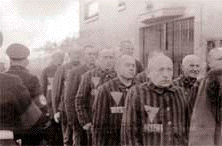
Moving onto an easier way to see victimization, the 1997 film based off the 1979 play by Martin Sherman, Bent, is the story of victimization of homosexuals in Nazi Germany. First, the main character, Max, plays both role of victim and victimizer. In the most basic terms, he is a victim of the Nazis because he is a homosexual and a prisoner for that fact. He is also a victimizer as he is brainwashed by the Nazi way. When he is given his identification patch, he was supposed to get a pink downward facing triangle to show his homosexuality. However, he struck a deal with the SS so that he could have a gold star, symbolizing that he was a Jew. He is brainwashed so much that he denies his homosexuality and condemns homosexuality altogether. Thus, he becomes a victimizer to his homosexual work friend, Horst.
Back track a bit in the film, there is another situation in this film I would like to examine. After Max, is taken into captivity onto the train, Nazi SS Officers bust their way onto Max’s train car. The SS choose Max’s ‘lover’ of sorts, Rudy, because he is wearing glasses; a sign of weakness in the Nazi view. They him into the next car and beat him half to death. The SS brings back the half-beaten man, and asks Max a series of questions on if he knows the man. He tells Max to hit his ‘lover’ with a club. For a brief second, the camera shows the commanding SS officer sitting down alone and rubbing his eyes in sadness, he also has glasses himself. That shows an example of how the organization is the victimizer in many cases and how the system victimizes the individuals within that system.
In conclusion, it is not a valid solution to try to eliminate a certain victimizer. Rather, it makes more sense to seek out the organization from which that victimizer comes from.

